

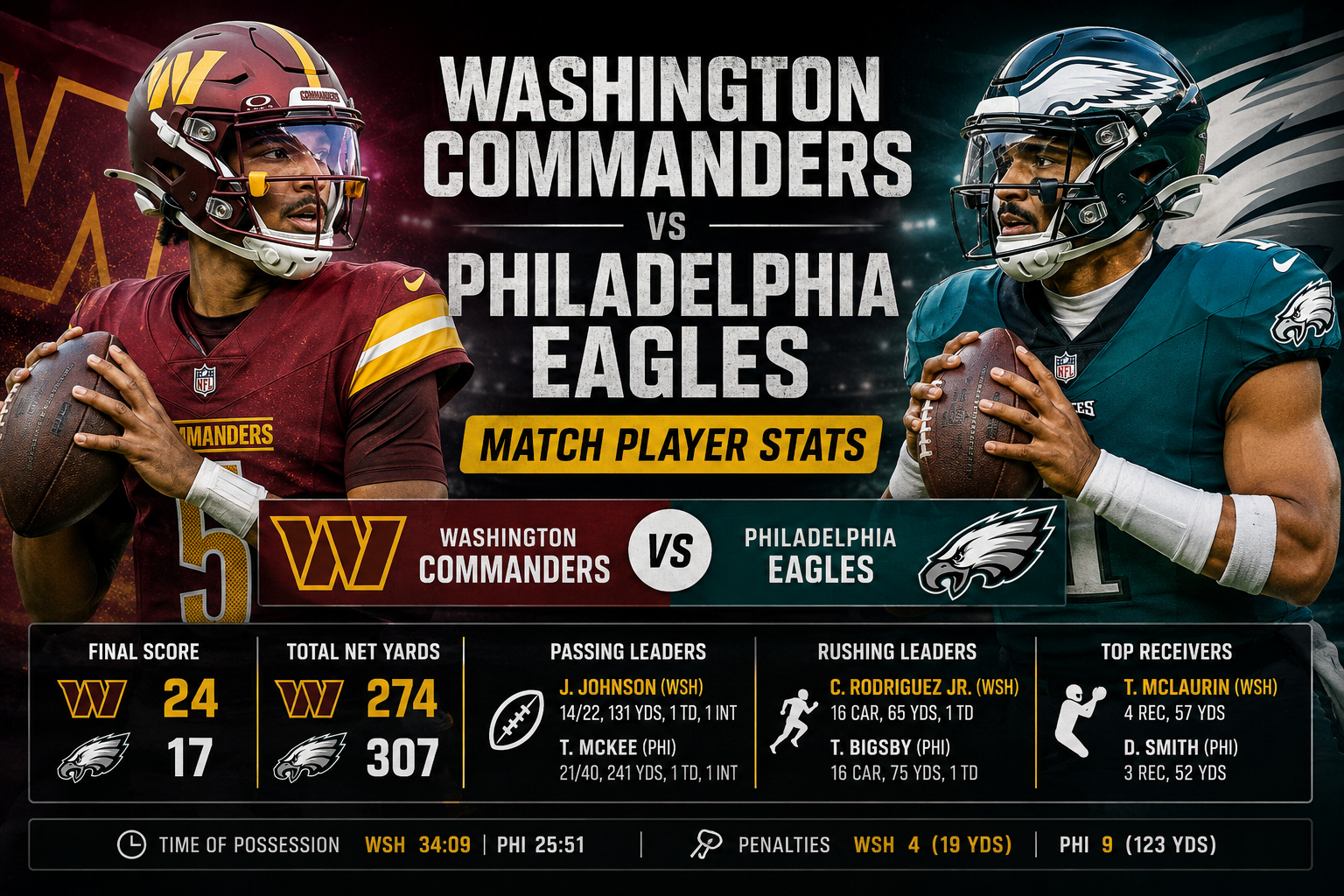
The latest washington commanders vs philadelphia eagles match player stats tell a clear story: Washington won the most recent meeting 24–17, but Philadelphia still produced more total yards.
This was not a flashy shootout. It was a controlled, physical NFC East game where field position, penalties, rushing balance, and late-game execution mattered more than big highlight plays.
For fans checking the washington commanders vs philadelphia eagles match player stats, the biggest takeaway is simple: Washington made fewer mistakes and got enough from Josh Johnson, Chris Rodriguez Jr., Terry McLaurin, and the defense to finish the job.
As one line perfectly fits this matchup, “Stats tell you who moved the ball, but timing tells you who owned the game.”
Match Result: Commanders 24, Eagles 17
The Washington Commanders defeated the Philadelphia Eagles 24–17 in the latest meeting between the two NFC East rivals.
Philadelphia had 307 total net yards, while Washington finished with 274 total net yards. On paper, that makes the Eagles look slightly better offensively.
But football is not played only on yardage. Washington controlled the ball for 34:09, while Philadelphia had it for 25:51.
That time-of-possession edge helped Washington slow the game down, protect its defense, and keep the Eagles from building rhythm.
Quick Team Stats Summary
| Category | Commanders | Eagles |
|---|---|---|
| Final Score | 24 | 17 |
| Total Net Yards | 274 | 307 |
| Penalties | 4 | 9 |
| Penalty Yards | 19 | 123 |
| Time of Possession | 34:09 | 25:51 |
The most important number here is not total yards. It is penalty yards.
Philadelphia gave away 123 penalty yards, which is like handing the opponent free field position again and again.
That is why the washington commanders vs philadelphia eagles match player stats need context. The Eagles moved the ball, but their mistakes made the game harder than it needed to be.
Commanders Passing Stats
Josh Johnson led Washington’s passing attack with a steady performance.
He completed 14 of 22 passes for 131 yards, with 1 touchdown and 1 interception.
Those numbers are not massive, but they were useful. Johnson did enough to keep the offense moving and avoided turning the game into a disaster.
His passing line was more about control than explosion. Think of it like a driver staying in the correct lane during heavy traffic — not flashy, but effective.
Commanders Passing Table
| Player | Completions/Attempts | Yards | TD | INT |
|---|---|---|---|---|
| Josh Johnson | 14/22 | 131 | 1 | 1 |
Johnson also helped with his legs, which made his full performance more valuable than the passing total alone.
For readers searching washington commanders vs philadelphia eagles match player stats, Johnson’s total impact matters because he contributed as both a passer and runner.
Eagles Passing Stats
Tanner McKee carried the passing load for Philadelphia.
He completed 21 of 40 passes for 241 yards, with 1 touchdown and 1 interception.
McKee threw for more yards than Johnson, but he needed many more attempts to get there. His completion rate also showed how difficult it was for the Eagles to stay consistent.
The Eagles had chances, but the passing game did not fully take control. There were productive moments, but not enough clean drives.
Eagles Passing Table
| Player | Completions/Attempts | Yards | TD | INT |
|---|---|---|---|---|
| Tanner McKee | 21/40 | 241 | 1 | 1 |
McKee’s stat line shows effort and volume. Johnson’s line shows efficiency and support from the running game.
That difference helped shape the result.
Commanders Rushing Stats
Washington’s ground game was the quiet engine of the win.
Chris Rodriguez Jr. rushed 16 times for 65 yards and 1 touchdown. He was the Commanders’ top rusher and gave the offense a reliable base.
Josh Johnson added 45 rushing yards on 9 carries, plus 1 rushing touchdown. That extra mobility made Philadelphia defend more than just traditional handoffs.
Jacory Croskey-Merritt also added 29 yards on 13 carries, helping Washington keep the ball moving and burn clock.
Commanders Rushing Table
| Player | Carries | Yards | Long | TD |
|---|---|---|---|---|
| Chris Rodriguez Jr. | 16 | 65 | 12 | 1 |
| Josh Johnson | 9 | 45 | 13 | 1 |
| Jacory Croskey-Merritt | 13 | 29 | 8 | 0 |
| Jeremy McNichols | 1 | 3 | 3 | 0 |
| Deebo Samuel | 2 | 1 | 1 | 0 |
This was not a rushing explosion. It was more like steady pressure.
“In a rivalry game, a four-yard run can feel like a punch if it keeps the clock moving and the defense tired.”
That is exactly what Washington did.
Eagles Rushing Stats
Tank Bigsby led the Eagles’ rushing attack with 16 carries for 75 yards and 1 touchdown.
That was one of the best individual offensive lines of the game. Bigsby averaged enough per carry to keep Philadelphia dangerous on the ground.
Tanner McKee added 3 rushing yards, and Will Shipley had 2 yards on one carry.
Eagles Rushing Table
| Player | Carries | Yards | Long | TD |
|---|---|---|---|---|
| Tank Bigsby | 16 | 75 | 13 | 1 |
| Tanner McKee | 2 | 3 | 2 | 0 |
| Will Shipley | 1 | 2 | 2 | 0 |
Bigsby was efficient, but Philadelphia did not get enough balance around him.
The Eagles had passing yards and rushing production, but penalties and missed opportunities stopped them from turning those yards into more points.
Commanders Receiving Stats
Terry McLaurin led Washington’s receivers with 4 catches for 57 yards.
He remained the most reliable wide receiver in the Commanders’ passing game. Even when the offense was conservative, McLaurin created important gains.
Deebo Samuel added 2 catches for 20 yards, while John Bates caught 2 passes for 13 yards and 1 touchdown.
That touchdown from Bates was a key example of how role players can decide tight games.
Commanders Receiving Table
| Player | Receptions | Yards | Long | TD |
|---|---|---|---|---|
| Terry McLaurin | 4 | 57 | 25 | 0 |
| Deebo Samuel | 2 | 20 | 16 | 0 |
| Chris Rodriguez Jr. | 1 | 18 | 18 | 0 |
| John Bates | 2 | 13 | 11 | 1 |
| Treylon Burks | 2 | 12 | 6 | 0 |
| Jeremy McNichols | 1 | 8 | 8 | 0 |
| Ben Sinnott | 2 | 3 | 2 | 0 |
McLaurin’s numbers may not look huge, but he gave Washington a dependable target when they needed one.
In the washington commanders vs philadelphia eagles match player stats, McLaurin stands out as Washington’s top receiving threat.
Eagles Receiving Stats
DeVonta Smith led the Eagles with 3 catches for 52 yards.
Jahan Dotson had 3 catches for 40 yards, and D. Cooper added 3 catches for 33 yards.
Grant Calcaterra caught 2 passes for 21 yards and 1 touchdown, giving Philadelphia its receiving score.
Eagles Receiving Table
| Player | Receptions | Yards | Long | TD |
|---|---|---|---|---|
| DeVonta Smith | 3 | 52 | 27 | 0 |
| Jahan Dotson | 3 | 40 | 16 | 0 |
| D. Cooper | 3 | 33 | 17 | 0 |
| Tank Bigsby | 1 | 31 | 31 | 0 |
| Kylen Granson | 4 | 30 | 12 | 0 |
| Grant Calcaterra | 2 | 21 | 15 | 1 |
| Britain Covey | 2 | 20 | 12 | 0 |
| Will Shipley | 2 | 11 | 12 | 0 |
| A.J. Dillon | 1 | 3 | 3 | 0 |
Philadelphia spread the ball around well, but no receiver completely took over.
That is important because the Eagles had enough passing yards to win, but not enough finishing power in the red zone and key moments.
Best Offensive Players in the Match
For Washington, the most important offensive player was Chris Rodriguez Jr.
He gave the Commanders 65 rushing yards and a touchdown, helping them control possession and finish drives.
Josh Johnson also deserves credit because he had 131 passing yards, 45 rushing yards, and 2 total touchdowns.
For Philadelphia, Tank Bigsby was the offensive standout with 75 rushing yards, 31 receiving yards, and 1 rushing touchdown.
If we judge by total offensive impact, Bigsby was one of the strongest players on the field despite the Eagles’ loss.
Defensive Standouts
Jeremy Reaves was a major name for Washington’s defense.
He finished with six total tackles, two passes defended, and one interception.
That interception mattered because turnovers in close games often act like hidden touchdowns. They stop one scoring chance and can create another.
Bobby Wagner also made his presence felt with five tackles in the season finale.
Washington’s defense was not perfect, but it was disciplined enough to hold Philadelphia to 17 points.
Why Washington Won the Game
Washington won because it played cleaner football.
The Commanders had only 4 penalties for 19 yards, while the Eagles had 9 penalties for 123 yards.
That gap is huge. It is hard to win a close game when you give away more than a full field of penalty yardage.
Washington also controlled the clock, leaned on the run game, and got enough timely plays from its defense.
The washington commanders vs philadelphia eagles match player stats show that Philadelphia had yardage, but Washington had control.
Why Philadelphia Lost Despite More Yards
The Eagles finished with more total yards, but they were not sharper.
Tanner McKee threw for 241 yards, and Tank Bigsby had a strong all-around game, but Philadelphia could not turn enough drives into points.
The penalties were the biggest problem. 123 penalty yards kept pushing the Eagles backward and extended Washington’s control of the game.
Football can be simple sometimes: yards help you move, but mistakes decide whether you score.
That is why the Eagles’ stat sheet looked competitive, but the scoreboard did not favor them.
Recent Comparison: Eagles 29, Commanders 18
Before Washington’s 24–17 win, Philadelphia beat Washington 29–18 in Week 16.
In that game, Jalen Hurts completed 22 of 30 passes for 185 yards and 2 touchdowns with no interceptions.
Saquon Barkley was the biggest star, rushing 21 times for 132 yards and 1 touchdown.
A.J. Brown added 9 catches for 95 yards, while DeVonta Smith had 6 catches for 42 yards and 1 touchdown.
That earlier game showed Philadelphia at its best: balanced, physical, and efficient.
What Changed Between the Two Games?
The biggest change was rhythm.
In the 29–18 Eagles win, Philadelphia controlled the important moments and leaned on Barkley’s running power.
In the 24–17 Commanders win, Washington controlled the clock and made fewer mistakes.
The player stats show two very different types of games. One was Philadelphia imposing its strength, while the other was Washington winning through patience and discipline.
That is why washington commanders vs philadelphia eagles match player stats are useful beyond one box score. They show how quickly the same rivalry can change.
NFC Championship Context
The most explosive recent matchup was the NFC Championship game, where Philadelphia defeated Washington 55–23.
That game was dominated by the Eagles’ ground attack. Saquon Barkley rushed for 118 yards and 3 touchdowns, while Jalen Hurts added multiple total touchdowns.
Jayden Daniels still produced for Washington, throwing for 255 yards and adding value with his legs.
But turnovers and explosive rushing plays changed everything. Philadelphia played like a team with a clear identity, and Washington could not slow the game down.
That matchup remains one of the strongest examples of how dangerous the Eagles can be when their run game is rolling.
Biggest Takeaways From the Player Stats
The washington commanders vs philadelphia eagles match player stats show three major points.
First, Washington’s latest win came from discipline, not dominance.
Second, Philadelphia’s offense can still move the ball even when it loses.
Third, rushing production remains one of the biggest keys in this rivalry.
Here are the clearest takeaways:
- Chris Rodriguez Jr. gave Washington a steady rushing base.
- Josh Johnson added value as both passer and runner.
- Terry McLaurin remained Washington’s most trusted receiver.
- Tank Bigsby was Philadelphia’s best all-around offensive player.
- Tanner McKee had volume, but not enough efficiency.
- Penalties crushed Philadelphia’s chances.
- Washington’s defense made the timely plays.
These points explain the game better than the final score alone.
Final Verdict
The latest washington commanders vs philadelphia eagles match player stats prove that Washington’s 24–17 win was built on control, patience, and cleaner execution.
Philadelphia had more total yards, but the Eagles hurt themselves with penalties and could not finish enough drives.
Washington did not need a superstar-level offensive explosion. The Commanders needed solid quarterback play, a steady run game, one or two defensive stops, and fewer mistakes.
That is exactly what they got.
For fans, analysts, and casual readers, the main lesson is clear: in Commanders vs Eagles games, the winner is often the team that runs better, protects the ball, and avoids giving away free yards.